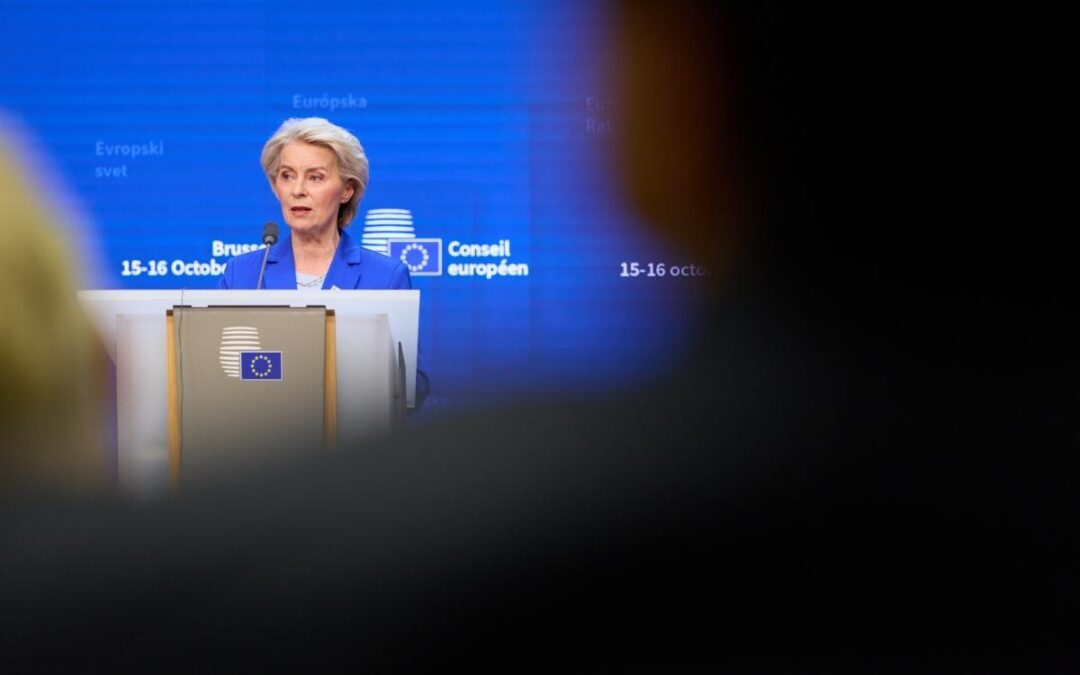
Commission President Ursula von der Leyen confirmed last week that her trade department is developing a new instrument to restrict access to the EU Single Market when foreign countries threaten European interests. Inspired by a position paper from France and Germany, it would give the EU a faster, broader way to respond to economic distortions. But another defensive tool is hardly, by itself, a trade strategy.
The Franco-German proposal would allow the Commission to respond to severe or persistent market distortions, from industrial subsidies to currency manipulation. Measures could range from tariffs to import restrictions, targeting individual products, entire sectors or countries. Crucially, the proposal envisages allowing measures to proceed unless a qualified majority of member states opposes them, potentially making action easier than under existing procedures.
The idea is to give Brussels more leverage over trading partners that benefit from unfair competition. China is the obvious target, but the instrument would be country-neutral, meaning it could also be used against the United States or other partners. Whether it becomes a new legal instrument or builds on existing powers remains unclear.
The hybrid trap
The EU’s recent experience with Chinese cars illustrates both the need for action and its limitations. After imposing anti-subsidy duties on Chinese battery-electric vehicles in 2024, Brussels watched Chinese manufacturers increase exports of hybrids, which the measures did not cover.
Last week, the Commission secured an agreement with Beijing to limit Chinese hybrid exports to 350,000 vehicles annually. The arrangement is intended to reduce shipments by around 45%. But the EU could not simply impose a China-specific quota at will: safeguard measures generally apply to imports across suppliers and require an investigation. Negotiating an export limit with China offers another route, but also illustrates the awkward balance between enforcing trade rules and finding a practical solution with Beijing. Neither approach resolves the wider imbalance between Chinese production and European demand.
More tools, same problem?
The EU already has anti-dumping and anti-subsidy duties, safeguards and its Anti-Coercion Instrument, which allows it to respond to economic pressure from foreign governments. The case for another instrument is that existing measures can be slow, narrow and poorly suited to distortions affecting entire industries. A faster response could help European producers before damage becomes irreversible.
But tariffs and restrictions are defensive by nature. They can provide temporary relief while raising costs for European manufacturers that depend on imported inputs, inviting retaliation and straining relations with trading partners. They do little to address the underlying causes of persistent imbalances, including state-backed overcapacity and weak domestic consumption in China.
Diversify, don’t just defend
The Commission’s December agenda offers a broader approach. On 9 December, it is expected to present its DiversifyEU package, aimed at reducing dependence on single suppliers for critical goods. A separate solidarity mechanism would help member states or industries facing economic coercion or retaliation.
These initiatives matter because Europe’s vulnerability cannot be fixed through trade restrictions alone. The EU needs alternative suppliers, stronger industrial capacity and closer partnerships with reliable trading partners. New trade agreements can help, but opening markets elsewhere is no substitute for addressing problems with established partners.
The new instrument may give the Commission a stronger hand at the negotiating table. The real test is whether the EU uses that leverage as part of a coherent strategy — one that protects European industry without making trade more costly, unpredictable and confrontational for everyone.