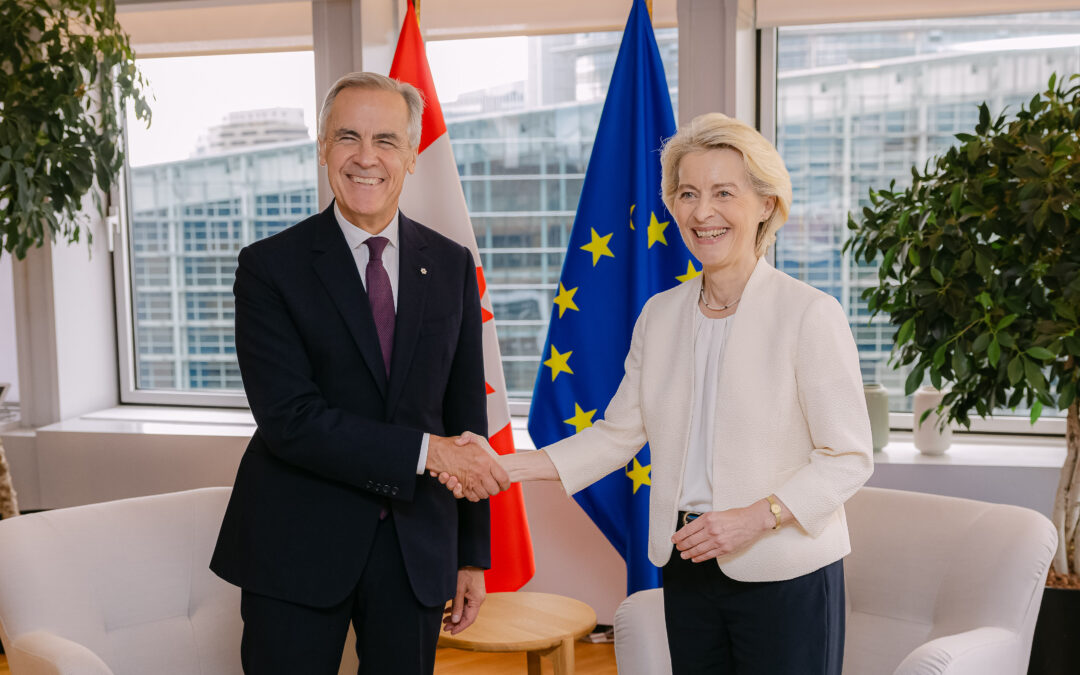
With a world full of enemies and adversaries, Canada is one of the EU’s truest – at least, if you ask Commission and European Council presidents Ursula von der Leyen and António Costa. They are in Montreal on 29 and 30 October for a summit with Canadian Prime Minister Mark Carney, aiming to turn a close relationship into a more ambitious alliance. The agenda spans trade, technology, critical minerals and defence. But before the two sides can build a new partnership, the EU must decide what it is offering — and how far it is willing to go.
In September, von der Leyen surprised EU capitals by proposing that Canada become the bloc’s first “associate member”. The idea was to forge closer ties without full EU membership. But several governments, including Germany, France and Greece, objected to the label. Their concern was not necessarily the ambition, but the lack of a clear definition: What would associate membership mean in practice, and what legal or political commitments would it entail?
The latest draft summit statement drops the term. Instead, the two sides will work towards defining an “ever closer association”, short of full membership, by their next summit in 2027. It is a diplomatic retreat, but not a retreat from closer ties. Carney has also made clear that he cares more about practical benefits than the name. The challenge now is to turn a grand political idea into a workable plan.
Less talk, more trade
There is already a solid foundation to build on. EU-Canada trade in goods and services reached €130 billion in 2025, up more than 80% from 2016. The Comprehensive Economic and Trade Agreement (CETA), provisionally applied since 2017, has helped deepen those ties. Now the two sides want to move beyond conventional trade.
The latest draft statement says they have “concluded substantive negotiations” on a Digital Trade Agreement. It is intended to make cross-border digital business more predictable, including through rules on data flows. The wording is significant: Political agreement appears within reach, but practical details still need to be settled. The summit is also expected to advance cooperation on AI and supercomputing, and announce an agreement with the European Investment Bank to facilitate European investment in Canadian critical raw materials.
The wider plan is ambitious. It covers energy, semiconductors, quantum technologies, pharmaceuticals, subsea cables and closer defence-industrial cooperation. Canada is already participating in the EU’s €150 billion Security Action for Europe (SAFE) defence instrument. The summit aims to connect more of these initiatives under a single political framework: an “Alliance for the Future”.
Diversify, diversify, diversify
The timing is no accident. Carney wants to reduce Canada’s reliance on the United States, which buys the vast majority of Canadian exports. The EU, meanwhile, is looking to reduce strategic dependencies and find reliable partners as trade tensions with Washington and competition with Beijing reshape the global economy. Canada offers what Europe needs: access to critical minerals, energy resources and a strong research base. Europe offers a large market, industrial expertise and investment.
Closer ties could help both sides diversify without turning away from global trade. Rather than building a fortress around either economy, they want to connect supply chains, coordinate economic security measures and make it easier for businesses to operate across the Atlantic. That is the promise of the alliance: More options, fewer vulnerabilities.
Friends, not twins
Still, shared concerns do not mean identical interests. Canada’s energy resources include liquefied natural gas, while the EU must balance energy security with its climate commitments. The draft statement accordingly proposes a feasibility study on Canadian LNG exports to Europe, framed around both sides’ climate goals. The two sides may also disagree on how far to align their rules, or how to balance open markets against industrial protection.
Nor is the EU a single actor with a single view. The backlash against associate membership showed how quickly a Commission proposal can run into national objections when governments have not agreed on the destination. Negotiating with Canada will bring its own differences.
That is why the summit matters beyond the announcements. The EU and Canada already have trade agreements, security cooperation and a growing list of joint initiatives. What they need now is a framework to turn these separate efforts into lasting cooperation — and a way to manage disagreements when their interests diverge.
The opportunity is real. But an alliance is not built by giving a partnership a grand name. It is built by delivering on the details.