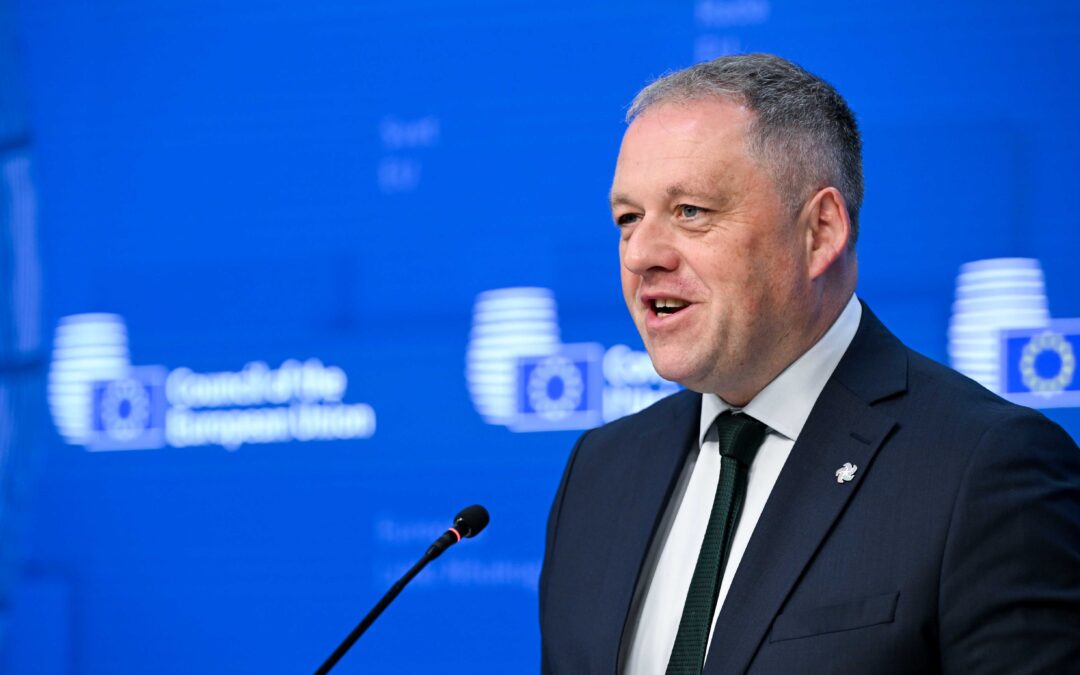
On Saturday (10 October), Irish Minister of State for European Affairs Thomas Byrne presented a revised negotiating position for the bloc’s 2028–2034 budget, the so-called Multiannual Financial Framework (MFF). The proposal cuts €159 billion from the European Commission’s nearly €2 trillion plan, largely to appease Germany and other countries demanding tighter spending. But the cuts have failed to win over the budget’s biggest critics – and have instead drawn opposition from the Commission, other member states and the European Parliament.
The Irish proposal shields agriculture and regional development, which together account for almost half of the EU budget, from cuts. Instead, it removes €75 billion from competitiveness funding, €38 billion from external action, including development aid, and reduces administrative spending by €10 billion. Ireland has also scrapped financial reserves designed to help the EU respond to unexpected crises. Byrne presented the changes as a compromise between the bloc’s 27 governments, balancing traditional spending priorities with investment in Europe’s future.
The frugals want more. Germany, Sweden, Denmark, the Netherlands, Finland and Austria argue that the proposed reductions do not go far enough. The group, which contributes around 40% of the EU budget, wants cuts worth several hundred billion euros. German Chancellor Friedrich Merz said the proposal was not a basis for an agreement, while Dutch Finance Minister Eelco Heinen warned that, at the current pace, a deal by the end of the year was unlikely. The frugals also object to the overall increase in spending and question whether the budget is affordable for the countries financing it.
The Commission has warned that the cuts would undermine its plans to strengthen European competitiveness and reduce the bloc’s vulnerability to external shocks. It is particularly concerned about the removal of financial reserves, which could leave the EU less able to respond to natural disasters, public health emergencies or geopolitical crises. The revised proposal also weakens the link between EU funding and economic reforms in member states, a mechanism the Commission sees as a way to encourage governments to improve their economies.
No consensus elsewhere, either. Southern and eastern member states, grouped as the Friends of Cohesion, welcomed the protection of agricultural subsidies and regional funding but remain dissatisfied with the overall size of the budget. Meanwhile, the European Parliament has rejected the proposal as a starting point for negotiations. MEPs argue that an 8% cut to the Commission’s plan would leave the EU underfunded at a time when it is expected to spend more on competitiveness, defence and security. They also want new EU revenue sources, including levies on digital services, online gambling and crypto assets. Ireland made no substantial changes to the Commission’s proposed package of five new revenue streams.
EU leaders will discuss the proposal at their European Council summit on Thursday and Friday, 15 and 16 October, offering an early indication of whether a deal is possible by the end of the year. European Council President António Costa wants governments to conclude their negotiations before talks with Parliament begin in January. That is an ambitious timetable: Governments remain divided not only over how much the EU should spend, but also over what it should prioritise and how it should pay for it. Ireland’s compromise has brought those disagreements into sharper focus, rather than resolving them.